
Stress-test your idea

You arrive at this point in the build with a plan, a path to shipping charted, and pivot criteria. Between now and launch, three types of evaluations should guide your work while you build the product: user testing, hypotheses to measure behavior, and the identification of additional help you might need.
Why this matters
Across the GNI × NPA AI-Powered Next Gen News Sprint, teams built and shipped products faster than they usually do. Speed, however, didn’t make their blockers disappear. Planning for discovery, finding testers outside the newsroom, and preparing to collect evidence were all still open questions for the teams.
Each of these can pull the product away from the plan and the audience insights behind it. That’s why development needs to cover more ground than just code, back-end work, and architecture. A culture of fast and regular testing has to run alongside.
The method
1 | Put unfinished work in front of your users.
There is a recurring instinct: build out of sight and ship once everything is polished. But there’s risk in refining internally before hearing from the people the product is meant to serve. Test early instead, with rough versions: a clickable prototype, a static page, a draft newsletter.
User testing is a muscle that can weaken if not used, and adopting a testing rhythm is essential. Who you test with is equally important. Colleagues, interns, and journalism students can help surface usability problems, but they can’t tell you whether next-gen audiences in your market want to read, save, or return to your product. Always recruit from your target audience segment.
You come out of this moment with a testing routine. This can take the shape of a recruiting database that includes your target audience, a lightweight protocol you can repeat at each milestone, and a short log of what changed after each round of testing.
2 | Decide what behavior would validate your hypothesis.
Usability testing tells you whether people like the product and whether they use it the way you intended. By focusing on behaviors, you can also see what else they do, whether they come back, and whether they share it with others.
Several teams in our Sprint entered development without a habit of measuring behavior, and coaches helped them turn a product idea into statements they could test.
A useful hypothesis names who takes an action and what that signals. Graham Media Group, for instance, framed theirs as a question: “Can a reporter with an existing social presence move audiences from Instagram to an owned neighborhood hub?” Keep the list of hypotheses to test short and prioritized, and confirm that the product is instrumented to answer it before wider testing.

3 | Write your if-then scenarios before the data arrives.
Regular check-ins during the Sprint helped teams think in scenarios: If X goes well, we do Y; if X lags, we do Z. Deciding responses in advance lets a team act on evidence instead of reacting under pressure.
This kind of scenario can help shape launch sequencing, too. You end up with a one-page scenario plan: the two or three signals you’ll watch, the thresholds that trigger a change, what you’ll do in each case, and a date for each decision.
4 | Identify help you might still need.
By this point, remaining gaps in your approach might become visible: discovery shortfalls, analytics needs, revenue considerations. During the Sprint, newsrooms could call on expert coaches for 1-hour sessions built around a specific question.
Outside of the program, your team might seek that kind of support from a colleague on another desk, a peer in another newsroom, a freelancer, or a community of practice. The essence of this step is naming the need with precision.
The outcome should be a short map of your gaps. Each item should have a specific question attached, a possible source of help, and the point in the timeline when you’ll need it.
With a testing rhythm, a prioritized hypothesis list, if-then scenarios, and a map of the help you need identified, your team is ready for the last moment of the process: preparing to launch and evaluate the outcomes. The next section covers how to take the product public in a way that creates the impact you’ve spent this phase getting ready to see.

How Graham Media Group and Chicago Public Media test ahead of wide releases
Before promoting it widely, the team wanted to answer one question: What features would be most compelling to drive users from Instagram to an owned neighborhood hub?
To find out, they opened a trial with a select group of nearly 100 Instagram users who regularly engage with her social reporting. Nielsen messaged each directly with a preview link to The Heights Hub asking for their feedback. Testers followed that path, explored the different areas of the site, and filled out a form about their experience, what they liked most, and what they didn’t find compelling.
“We certainly have a ton of extra features we want to do down the road, but if we can get it feeling like it’s a good community space for a version 1 launch, we’ll be ready to have [Nicole] promote it on her social to reach a wider audience,” said Araz Hashemi, Business Intelligence Lead at Graham Media Group. “We want to make sure we have a strong case to present as to why they would want to make the leap from social to a separate community site.”
Through the trial period, the team has gotten a lot of feedback from next-gen audiences. Many commented on the intentional space to get just news about their neighborhood, and many appreciated the long-form text explainers that they can’t get on Instagram. The most called out feature was the clean design that isn’t inundated with ads, and that created a better sense of connection with the reporting. The team read this feedback as a signal: next-gen audiences are willing to consume news off social media if the sponsorships are minimal, intentional, and better integrated with the content.
The feedback also revealed an expectation gap — and an opportunity. People who submit story ideas seem to expect immediate results, not understanding the rigorous investigative process necessary to produce real journalism content. To address this, the team is adding a way for Nicole to post these process updates so the community can see what she is working on, what she has verified thus far, and what questions remain unanswered.
With the beta feedback of what next-gen audiences found most compelling, the team knows what messaging Nielsen should use as she makes her pitch to her social audiences to check out The Heights Hub.
The goal now is to get enough people checking regularly and participating in the forum that it becomes the destination people in The Heights go to learn and ask about everything happening in The Heights. Graham Media Group has plans to apply similar pilots in other markets and neighborhoods to assess whether the community concept can scale.
Anticipating the next move
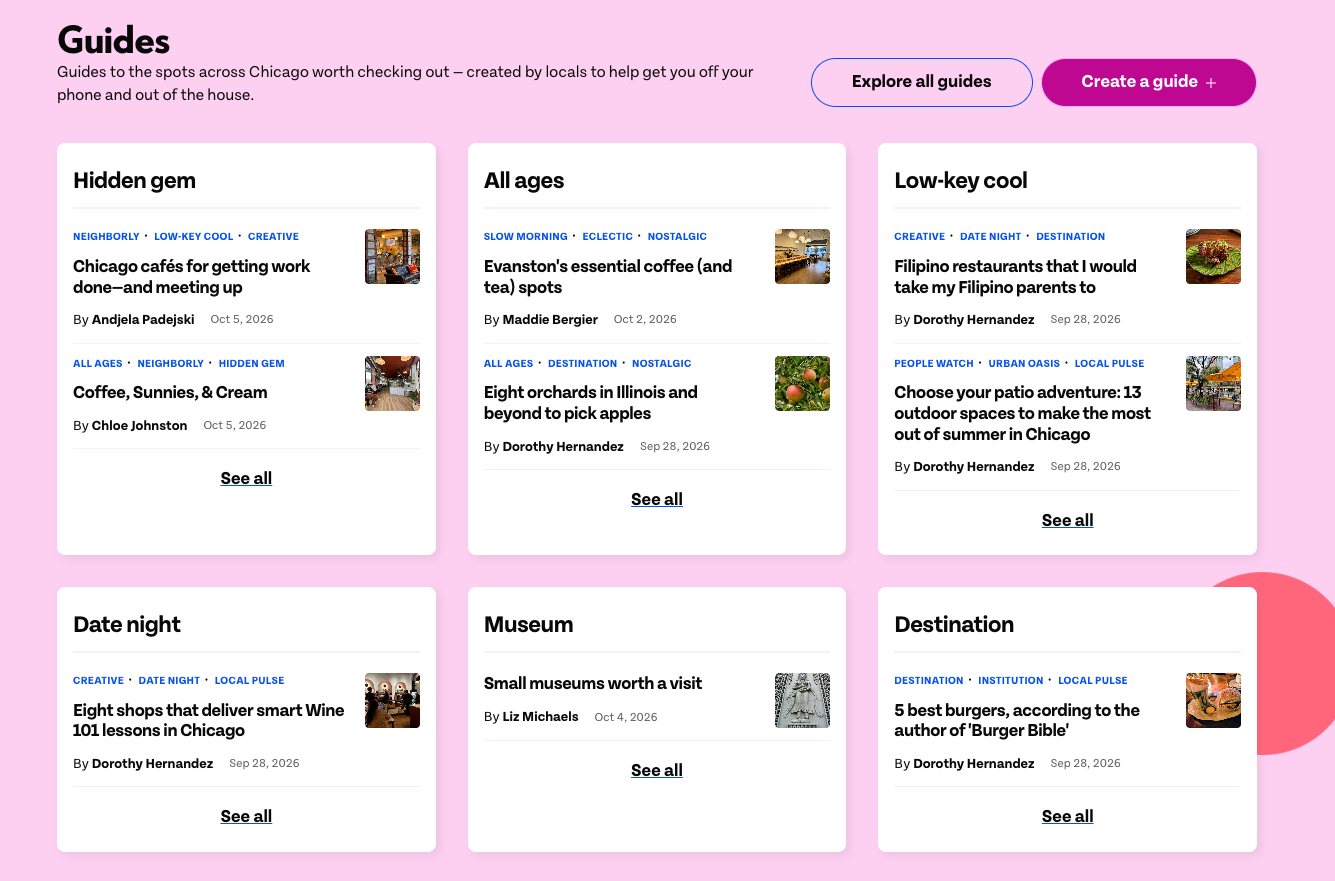
Chicago Public Media is building Guides, part of a larger initiative at chicago.com, where users can create, share, and discuss guides to their city.
Traditionally, guides and recommendations have been a one-way street, flowing from newsroom to reader. With Guides, Chicago Public Media is hoping to make the process of creating and sharing a guide easy for their audience. By democratizing this effort, they are hoping to build a community of users.
To get there, the team plans a soft launch in four neighborhoods and Evanston, a suburb just outside of Chicago. Leaning into what the Next Gen News 2 report calls scroll and seek modes, search and social media are meant to bring people to the guides, while the community forums act as a sticky layer for audiences.
“I’ll be happy for return users, people who are coming to see new guides, contribute new guides, and even more so, talk about those things on the community platform,” said Ellery Jones, Assistant Editor, Innovation at the Chicago Sun-Times.
Before the guides went live, however, the outlet had clearly named the signal that would tell them whether the bet had paid off: the number of guides created by users outside the newsroom. If users aren’t showing up, the team expects to make substantial changes and follow what their local next-gen audience tells them. With that response determined in advance, the soft launch can feed a decision as soon as the first data arrives.
During implementation, a team’s first instinct is often to refine and polish, and only let your audience see the product once it reaches its final version. That instinct can be costly. By the time a polished product meets its users, the key decisions have already been made without them.
The two snapshots that follow capture the moment when a team has a working version in progress and needs to start testing it. Each one shows a newsroom building testing cycles into development: regular touchpoints that bring every decision back to the audience needs behind the project and keep the team listening as the product takes shape.
Letting the users behind the curtain
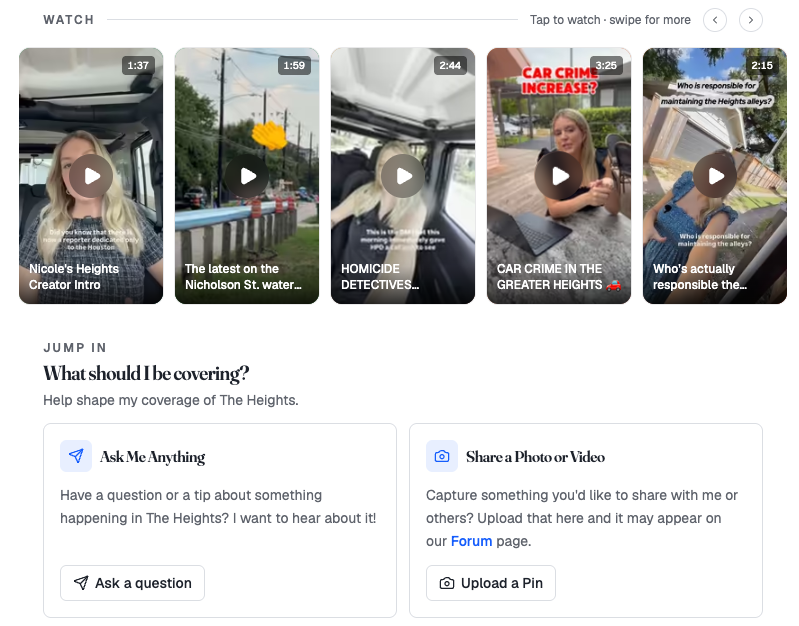
The Graham Media Group team created The Heights, a community hub on the website of KPRC-TV, its Houston station. This space allows local residents to connect with Nicole Nielsen, a broadcast reporter assigned to cover The Heights neighborhood and ask questions about the area or propose investigative story ideas.

What this means for your newsroom
Stress-testing your product regularly helps you and your team align before shipping. When testers see the product while it’s still rough, problems that would otherwise surface at scale show up early.
These can be usability issues: Graham Media Group’s testers stumbled on the core site’s sign-up process. Other testers raised media literacy questions, such as how a newsroom turns an idea into a video — and how a team can be transparent about that.
Establishing signals to watch and pivot criteria in advance, as Chicago Public Media did, turns the wider release into a checkpoint that the team has already agreed how to read.
In both cases, while the team makes technical decisions, each round of testing or evaluation aligns the product with the audience needs at its core.

Follow the Sprint

NEXT