
Ship and evaluate

If you got to this section, you likely have something that works in testing and a team that believes in it. There are two moments left: launching and evaluating.
Launch is where the whole newsroom (editorial, product, engineering, marketing, etc.) aligns behind the product and finds agreement in what it promises. In your evaluation, you will learn whether next-gen audiences find it, use it, and come back.
Why this matters
As you seek to future-proof your newsroom by reaching young audiences, the temptation can be to treat this next-gen challenge as only a distribution problem: Take what the newsroom already produces and reshape it for the platforms where people age 18 to 24 spend their time. A product, however, is more than its format or its channel.
What the newsrooms participating in the GNI × NPA AI-Powered Next Gen News Sprint built were products: a weekly newsletter with a point of view on what matters to people in their twenties, a platform for microdonations to specific reporting projects, a quiz that helps first-time voters match their values to candidates, a guide to eating well on a budget. Each one makes a promise to a specific type of person, depends on a path that brings that person in, and needs someone inside the newsroom to keep it going.
While a format describes how content looks, a product is the whole arrangement around it: the motivation to come, the way in, the reason to return, and the people who sustain it. Launch is the moment when the newsroom has to agree on all of that.
The method

1 | Remember your strengths.
Write down the promise that your product makes and what it offers that other alternatives don’t. Next-gen audiences already have other apps on their phones and many feeds to visit. In testing, teams in the cohort kept hearing some version of the same question: Why would I use this instead?
The answer comes from assets that others can’t copy: recommendations vetted by critics and reporters, local knowledge, or a distinct voice. Make that visible both inside the product and in how you describe it. Avoid positioning it as “for young people.” No one likes being talked down to — let the product show who its audience is.
The outcome: a one-line value proposition that your team agrees on, the foundation for all your product marketing.
2 | Recap next-gen engagement modes for promotion.
A product needs an entry point. Remember the sift modes from the Next Gen News 2 report’s modes of engagement framework. Recap the one that your product’s promotion and discovery depends on: scroll, seek or subscribe. Even if you picked subscribe at the beginning of your development process, you still might need to promote it on a platform with a scroll or seek layer to get people to sign up.
Name the platform where this first interaction with the product will happen, including the account or the page, the person who runs it, and the first three pieces of content related to it.
A great, well-designed product with no promotion plan is a familiar recipe for failed launches. In the cohort, the teams that saw early traction gave promotion the same rigor they gave the coding portion of their work: paid and local social promotion, use of reporters’ own accounts, and a marketing calendar tied to moments that are already important to their audience.

3 | Follow the user journey.
List every step between a first encounter and repeat use: the video promotion, the landing page, the sign-up form, the checkout process, the second visit.
Mark each step as “proven” if you’ve watched someone outside your organization do it; as “assumed” if you believe it will work but haven’t seen it happen; and as “unbuilt” if it doesn’t exist yet.
In the cohort, user journeys broke in predictable places: the jump from social media to an owned surface, a checkout process that people abandoned, a paywall between a recommendation and the reader.

4 | Align on launch commitments.
List every function that must be ready for launch: editorial, product, engineering, marketing, revenue, and legal where needed. Assign names and hours to those functions. Launch dates in the cohort slipped for reasons outside of the product itself: engineering time pulled to other priorities, a publishing workflow that rested on one person.
The result of accounting for these needs: a launch plan where every step has a status and each function has an owner.
5 | Measure performance and decide what next.
Set your learning window before launch and decide what signals you’re watching. Sign-ups and first visits will point to whether promotion worked. Return visits, repeat use, and the share of users who are new to your newsroom can help you see whether the product works for next-gen audiences.
At the end of this window, map what you shipped back onto the modes of engagement and compare it with what your research predicted. If the product’s mode of engagement changed along the way, document when and why. Then make the call: Scale it, iterate and keep going, or kill it. Tie the call to the signals you tracked.
The outcome of this whole process will be evidence of next-gen habits, a decision about the product’s future, and a documented answer about whether it reached the audience for which it was built.
Everything in this section fits in one document: the Go-to-Market Plan. Budget 90 minutes and fill it in during a single working session with representatives of every function in the room.
Resource:

How The Boston Globe and The Atlanta Journal-Constitution are evaluating the product performance
Launching your product marks not the end of the process, but rather the beginning of a real conversation with your intended next-gen audience. Newsrooms can no longer afford to start a new initiative and just let it play out. Instead, your team will need to determine how well your newly launched product aligns with next-gen audience needs. To do so, you and your team will need to ask and answer questions that help measure performance and determine next steps.
Launching less to learn more
The Atlanta Journal-Constitution heard a signal loud and clear during their research: next-gen audiences wanted relevant news delivered fast. Based on that, they prototyped the Daily Digest, an in-app experience that offers five stories picked every morning, readable or listenable, with an end point that tells readers they’re caught up.
Preparing for launch meant deciding what the first version of the product would feature. Their prototype from the design sprint had included a newsletter, a podcast, and AI-generated summaries. The first version left all three out on purpose. Additional formats could wait until the team had usage data. The summaries required a different conversation, one with the newsroom and the standards team.
“We really just wanted to get out the door and launch a true MVP; start seeing how people were interacting with it; and figure out where the opportunities were and how to iterate,” said Natalie Dixon, Head of Product at the Journal-Constitution, who led the work. "This would have been the first time we were producing AI-generated content, so we decided to pull that out of the MVP, just to get some clear learnings and get this out as quickly as possible.”
Entry points to the Daily Digest arrive in a morning push notification and a spot at the top of the app’s home screen, powered by a recommendation model that the team already had in place for one of its newsletters. The Digest launched in late summer 2026 as a subscriber-only feature. The team’s priority so far has been cultivating routine use of the feature before optimizing it.
The early numbers are encouraging: People who use the Digest come back to the app more often than those who don’t. The team is cautious about what that means, since it could reflect users who were already engaged. But that caution is also a way to keep making decisions after launch. For the Journal-Constitution, it leads to new rounds of evaluation: looking at whether the Digest helps turn trial users into paying subscribers, for instance, and conducting research with next-gen users that will guide which formats return in a future iteration.
Shipping a beta to keep learning
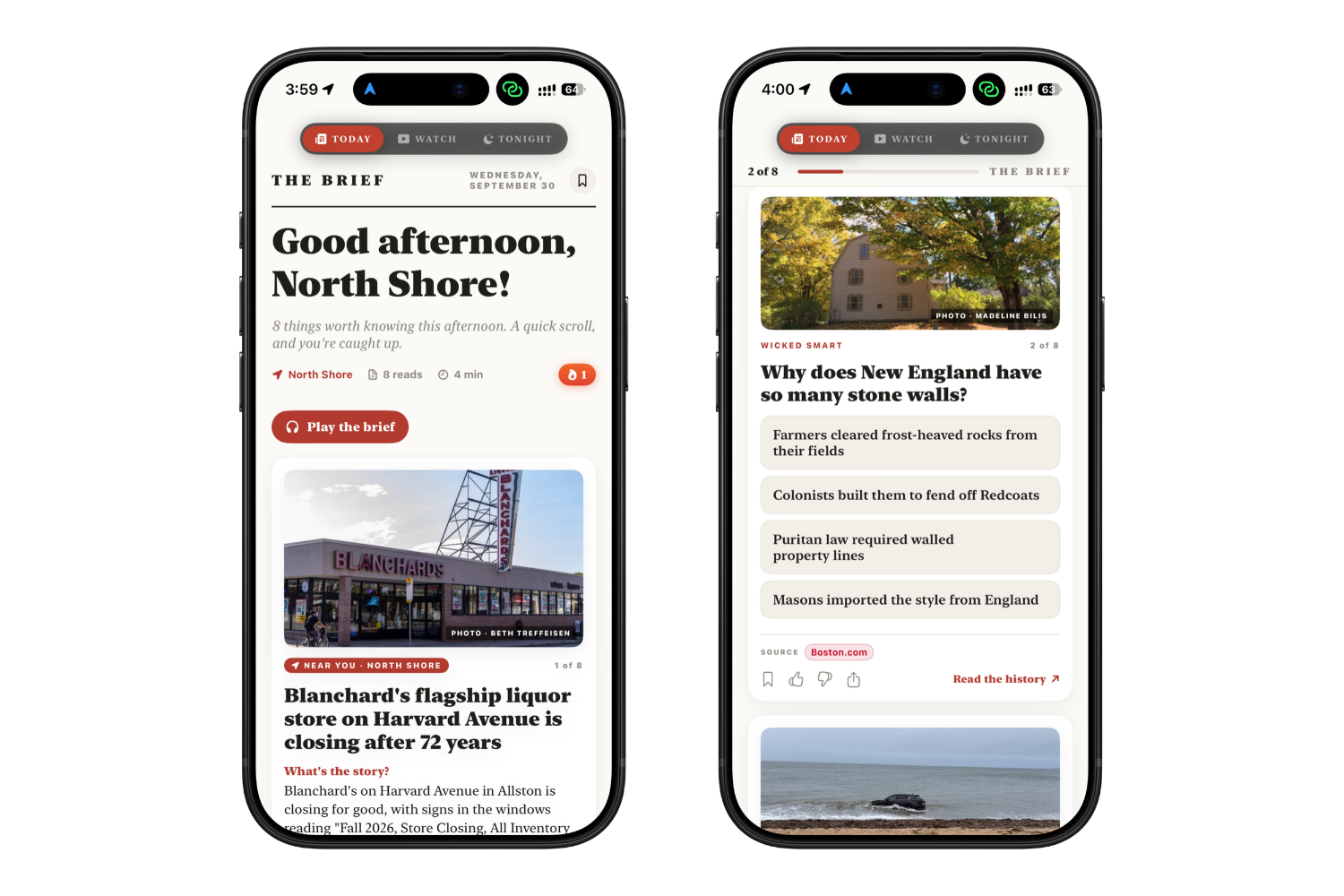
Following a similar format, The Boston Globe launched The Brief, a product delivered in the morning and in the evening, aimed at helping their next-gen audience keep up-to-date on the day’s news.
As a soft launch, the Globe advertised The Brief on both Reddit and Meta products, driving an initial set of users to a test of the product using the TestFlight app. It also partnered with one of their existing publications, The B-Side, which delivers news via email and social platforms. With a target audience under age 40, The B-Side was a natural fit for promotion.
The test let the team watch the user journey play out with people outside of the newsroom, which allowed them to check their assumptions at each step. Early signals pointed toward The Brief being a destination where people returned. The team saw repeat use as they analyzed data from the first weeks after the beta launch. Feedback they received also suggests that some next-gen audience members have begun to develop a ritual of reading The Brief in the morning and evening, upon checking their notifications.
Not all metrics have met their expectations. The Globe’s research indicated that next-gen users wanted audio versions of stories, but the audio included in The Brief has not gained much traction. Facing the choice between scaling, iterating, or killing the feature, the team chose to iterate. It is testing a different approach to audio and has rethought how it reads its own test results.
Matt Karolian, Vice President, Platforms and AI, at the Globe, explained this with an analogy: A restaurant that serves microwaved steaks is technically serving steak. But a customer who says they dislike it hasn’t told you they dislike all steaks.
“Historically, we erred on the side of doing a lot of microwave steaks, and come away saying, ‘People don’t like this’ or ‘They don’t like that,’ when they may have not actually been responding to the idea, but the way that we have tested it,” Karolian said.

What this means for your newsroom
Launching doesn’t mean the end of the process. Shipping a product is just the beginning of the real test, and what you include in the MVP determines how much you will learn from it.
The Journal-Constitution kept its first version small so early usage would speak to the core habit the team was trying to build. It is reading the first signals with care. The Globe treats a feature that hasn’t caught on as a question that guides its next steps. When something underperforms in your initial testing, especially during the first few weeks, it doesn’t necessarily mean you interpreted signals from your research incorrectly.
Product work is iterative. The teams in this cohort started with research, built toward launch, and found that shipping continued the learning process. That loop is the method. The newsrooms that will matter to future audiences are the ones reinforcing the habit of learning and iteration today.

Follow the Sprint