
Write the plan

You might come out of a design sprint with a prototype that tested well, but also with a group of people who each remember a different version of what needs to happen next.
This is the moment to write everything down and align expectations: who the product is for, what the smallest useful version looks like, how to measure its success, and what would tell you to change course.
Twelve newsrooms in the GNI × NPA AI-Powered Next Gen News Sprint each wrote an implementation plan two weeks after their design sprint, then went back over it with a coach a month later. This section captures that process.
Why this matters
A plan in writing is both a means of making a commitment and a guide for what to do and how to react. It enables alignment, establishes key metrics to observe, and allows teams to spot weaknesses before development begins.
This plan doesn’t have to be extremely detailed, but it does require enough specificity to serve as a reference point throughout the building process.
The method
1 | Connect the build back to the finding.
Start by tying every building decision back to a specific insight from your research, a specific audience segment, and most important, a specific mode of engagement. You can see examples in the Next Gen News 2 report.
Go beyond simple demographics and describe the segment’s behavior. “Age 18 to 28” is not an audience segment. The definitions that work best include sift and consumption modes (how they discover and digest information), geography, and even their life stage.
These life stages might include definitions such as “renters and early-career commuters who are social-native but never open a local news home page,” or “grad students new to a city who use Instagram messaging to figure out where to eat.” These descriptions give you a specific distribution starting point that you can use for your product.
The expected outcome of this step is a one-paragraph statement of what you’re building, for whom, in response to what.
2 | Define the smallest version that produces signals.
Scope the first iteration of your product. Beyond your prototype, what is the smallest version you could run to learn something meaningful before you make additional decisions about it?
Then define how you’ll know it is working: one outcome metric and one leading indicator you can watch along the way. These will be your key performance indicators for this product.

3 | Assign ownership and map the build.
Up to this point, the work has been research and prototyping: fast, collaborative, low-stakes, with everyone contributing a bit of everything. The implementation plan is the first moment when the work stops being everyone’s and starts being someone’s.
Name the project lead: Who owns this? Who is accountable for progress? Then name the functions involved (for instance, editorial, product, technology, audience, UX, revenue) and where each will focus.
Then map the work to a window of time no longer than six months. Where might the major checkpoints fall, and what does “done” look like at the end? By working backward, you can turn a series of initiatives into a sequence: what has to happen first, what goes next, what can wait until later, and what gets cut if the window tightens.

4 | Determine your pivot criteria and weak spots.
Alongside your success criteria, you need to define at least one trigger that would tell you to change direction. Projects mutate, and a plan cannot prevent that. It can, nonetheless, offer ways to identify when change is needed.
In the same vein, you need to make a list of areas where you’re least confident. Weak spots can include things like the following:
Discovery: Lack of a bridge between where the audience already is and where the product lives. Solution: a better-described segment that includes the starting distribution point.
Measurement: No reliable way to verify the age of the people using the product, thus no proof that next-gen audiences are engaging with it. Solution: a proxy you can actually collect (registration, email gating, an in-product question, a survey on a sample), defined before launch.
Revenue: No hypothesis, deferred on purpose or by omission. Solution: Name what this product is meant to produce (registrations, habit, subscription, donations, ads), even if you’re not building for it yet.
Audience validation: Testing was done with students or colleagues instead of the actual segment. Solution: one round of testing with people who match the segment definition, scheduled before the build is finished, ideally early in the road map.
Dependencies outside the team: A platform migration, an app rebuild, a vendor. Solution: Scope a version that ships without the dependency, or move the launch date to account for it.
The Implementation Plan and its Road Map take you through all four of these steps: your audience segment and findings, your first iteration and its KPIs, ownership and timeline, and your pivot triggers and risk assessment.
Once the plan is written, hand it to someone who wasn’t in the room. This might be a coach, a peer at another newsroom, or an executive who missed the sprint. Another pair of eyes can still find gaps before you start building.
Resources:

How The Minnesota Star Tribune and The Salt Lake Tribune kept their road maps honest
After researching, prototyping, and deciding where AI will live in your solution, it is now time for rubber to meet the road.
When designing a product, it can be easy to lose sight of what you’re building and why. A road map will tie every product decision back to specific insights from your research or a specific mode of engagement.
Doing this will prevent you from looking up after working for weeks or months on a project and wondering how you got so far away from what your next-gen audience was telling you.
Staying true to your grounding statements
The Minnesota Star Tribune team left the design sprint with the idea for The Brief – a personalized swipeable, card-based daily news briefing inside the Star Tribune app that included: a daily notification and greeting, weather and top stories with AI-generated summaries, a daily streak and events near you. They were heading into implementation, with an app rebuild already underway.
With that in mind, Katie Marfori, Senior Product Manager at the Star Tribune, led the team into refining what they had and aligning it to their insights and capacity.
“Our original vision was ambitious, and it should be. But with AI, the question stopped being 'can we build this?' and became 'should we build this?' So every iteration came back to the same thing: what has to be true for this to be valuable to readers and to the business?” she said, describing that moment.
Using the Implementation Plan template, the team was able to create a list of things that always needed to be true. If the team started running into questions about capacity, feasibility, outside pressures, and any other possibilities, having these statements would keep them on track:
Readers can get caught up on what's happening in Minnesota today in a few minutes, without (or with low) barriers and come back tomorrow to do it again.
[The product] engages more readers and deepens habits with existing readers, creating a pipeline for revenue (subscription conversion, retention and sponsorship).
Any manual work had to earn its value for readers and the business.
Learning would shape future iterations.
This made the planning of a V1 easier – with no personalization available and the app rebuild underway, the team prioritized a first version that could instead quickly generate a key signal: whether a cohort of lower engaged app users opened The Brief and found it valuable enough to return more frequently.
That would become their pivot criterion: If early tests showed that users were not reacting as expected, the team would change course.
Building sequences that meet your moment
The team at The Salt Lake Tribune heard that their local next-gen audience wanted to know what actions they could take after reading stories that impacted their communities. They defined an audience segment around that behavior: Utahns age 18 to 28 who are actively engaged in civic life, who are mobile-first, and who turn to social media or issue-specific news outlets to learn how to take action.
Following the Implementation Plan template, they wrote statements about what they planned to build, their target audience, the product’s connection to research, how AI would be used, what their differentiator was in the market, and a definition of done.
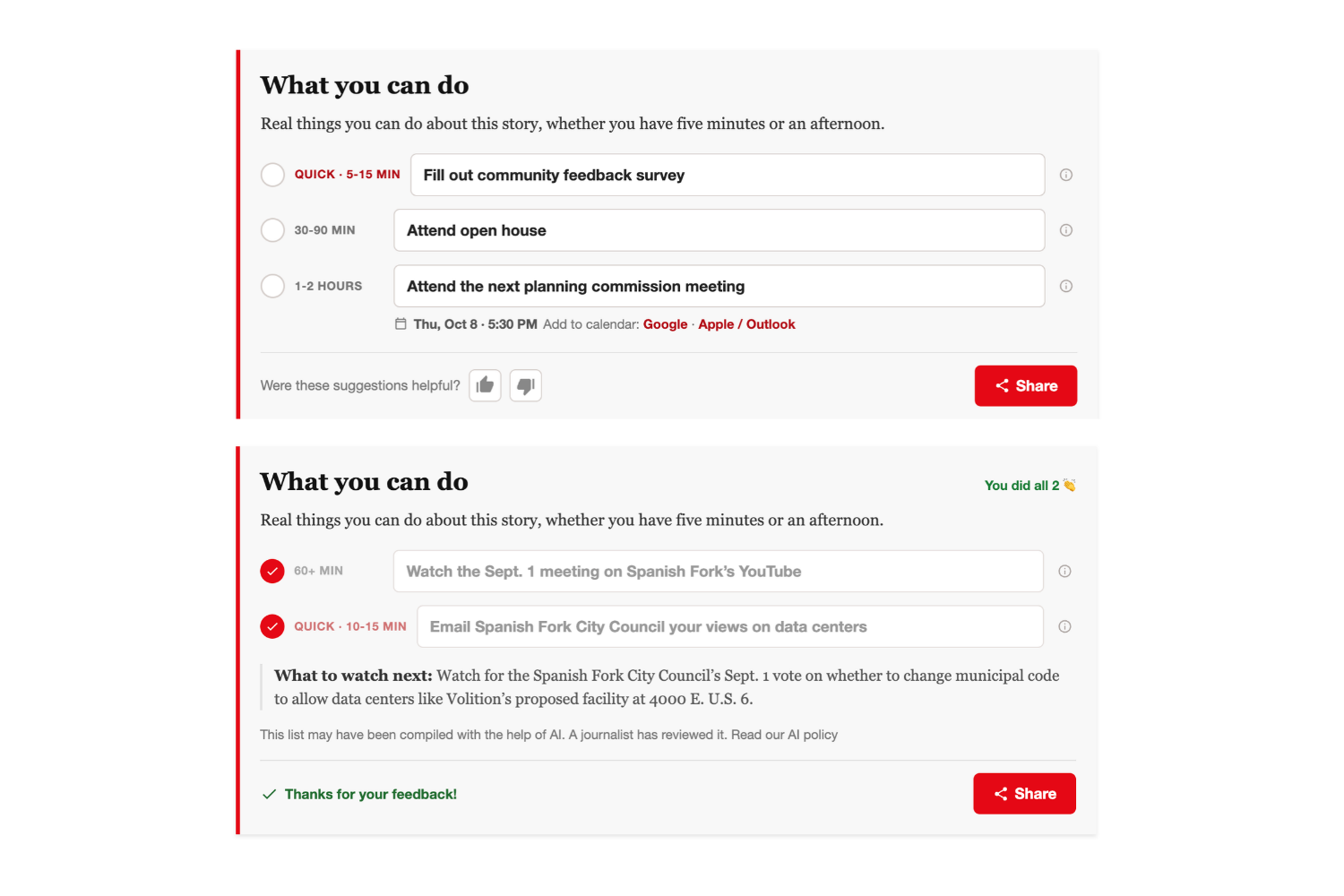
These statements guided them to distill their prototype down to a first version: the “What you can do” box, a widget that appears on select stories with next steps for the audience. Envisioning the smallest possible version of the widget and establishing clear guidelines was key for this team, as The Salt Lake Tribune was moving from being a subscription-based newspaper to a donation-sustained outlet.
As they laid out their plan, they agreed that the product team would own the initiative and set up the tracking and analytics; the editorial staff would pick the stories and the actions to be taken; and the audience team would track its impact. The statements they wrote defining the product would also help sequence the decisions ahead: which stories get the box first, the AI powering the workflow, where the share button goes, and what their AI policy should say about the product, since this was among the Tribune’s first public-facing uses of AI.

What this means for your newsroom
A road map charts your path to launch. An implementation plan forces you to anticipate and answer questions in advance. The Minnesota Star Tribune saw that its app rebuild and real AI capacity would shape The Brief’s development, so it planned around both from the start. The Salt Lake Tribune anticipated decisions they would need to make down the road and who would be responsible for each, while accounting for a major shift in its business model.
Having these plans in place before you start building a product gives your team a reference point when external pressures arise or decisions need to be made and prioritized.

Follow the Sprint
NEXT