
Design your idea

You are coming into this section with a set of insights. That’s what the organizations participating in the GNI × NPA AI-Powered Next Gen News Sprint did at an in-person event at the Reynolds Journalism Institute in March 2026. After two days, they came out with a rough prototype to which people age 18 to 28 had reacted.
This section is a step-by-step guide to turning your strategic challenge into something you can test.
Why this matters
The design-sprint format forces decisions that a team might have been circling around for weeks. By setting aside some protected time, getting the right people in one place, and focusing on learning, your team can move from a problem to a concrete solution and even get a prototype in front of users.
The method
1 | Discover.
Discover, the first moment in the process, is located at the beginning of the first diamond and follows a divergent path. In this part, your team should go through these steps:
Spread out the insights you carried from research.
Resist the temptation to jump to answers.
Sharpen your insights into one or two problem statements.
Open each problem into a How Might We (HMW) question.
A good HMW question is specific enough to spark ideas, but open enough that more than one answer is possible. Example: “How might we help first-time voters feel confident about who to vote for?” That question names the outcome — confidence deciding who to vote for — without naming the solution. A team could answer it with a quiz, a guide, a video, or something else nobody has yet envisioned.
If your HMW question has a single obvious solution, you are likely looking at a decision or answer in disguise and not a real question. Example: “How might we build a voter-candidate matching quiz?” This one has already picked the answer. The quiz is baked into the question, so there is nothing left on which to diverge. This also skips the outcome: It never says what the voter is trying to do. If your HMW question names a product or format, back up to express the need underneath it.
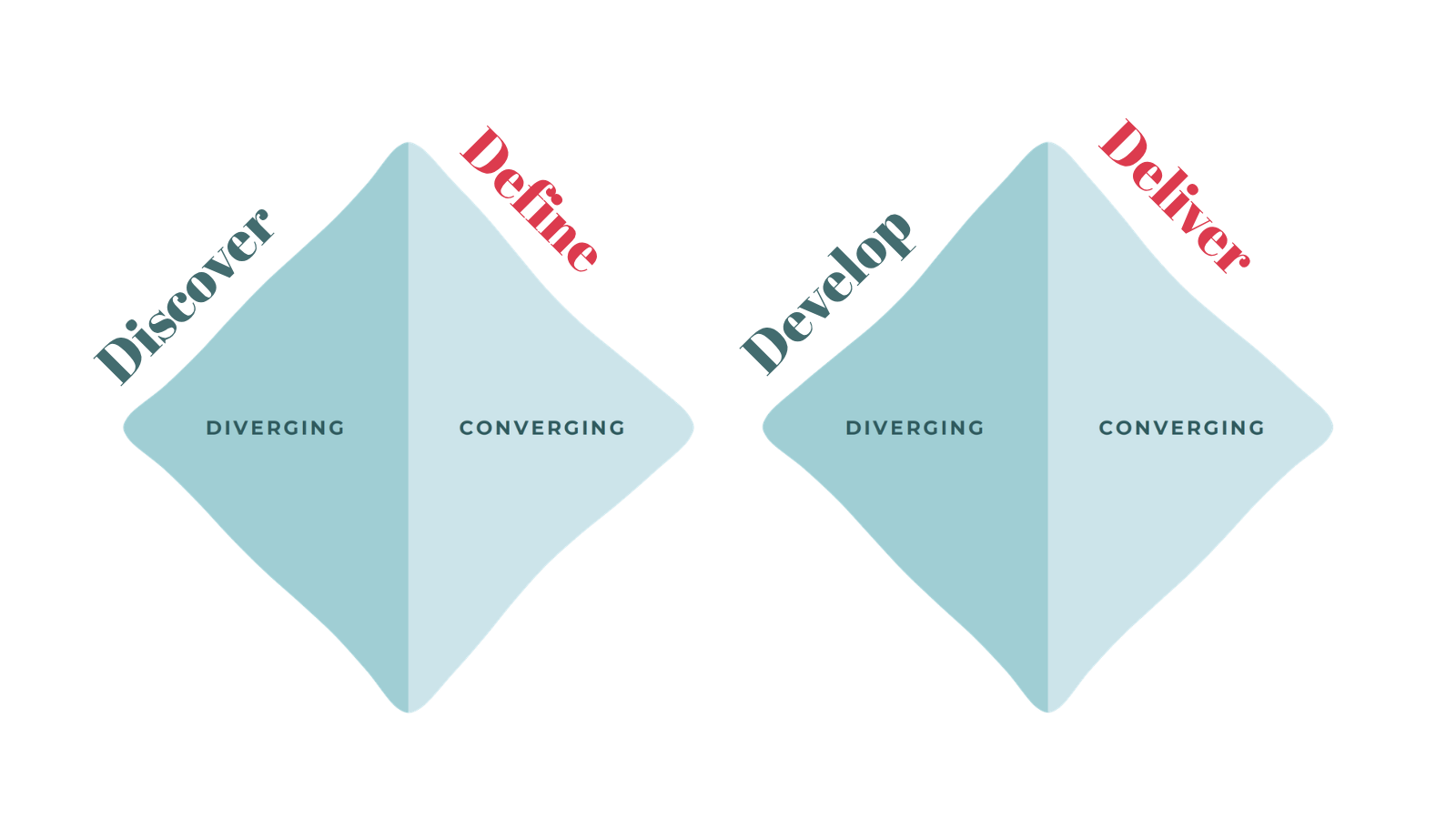
As the Double Diamond diagram, popularized by the British Design Council, illustrates, the design and innovation process moves around two big goals. The first one, represented by the diamond on the left, is finding the correct problem for which to design. The second goal, embedded in the diamond on the right, is about building the correct thing.
Four moments are represented by the Double Diamond chart: Discover, Define, Develop, and Deliver. Each moment follows one of two patterns. Actions in that moment can be divergent — with ideas and suggestions spreading, exploring many possibilities — or convergent, guiding teams toward making decisions and finally closing around concrete choices.
2 | Define.
Define sits at the point where the first diamond closes and follows a convergent path. This is where you take everything opened up in the Discover portion of the process and narrow it to a single, sharp problem that the audience is experiencing.
It is the most important moment in the sprint. Everything you build later is only as good as the problem you commit to addressing here. In this portion of the process, your team should go through these steps:
Cluster your insights and HMW questions and look for the question that matters most to your audience.
Draft a proto-persona of the primary user for which you are designing. This keeps the whole room designing for the same user instead of 10 different imagined ones. The decision of what type of user to focus on should also align with your organization’s goals and mission.
Name this user’s habits, what they care about in this context, and their pains. Be specific: a real life stage, a real need, or a real frustration. This is a great place to include their NGN2 modes of engagement.
Write down the assumptions you are still making about them. Anything you are guessing about your audience is something the prototype can test.
Along with the HMW question you select, this proto-persona is your problem definition: the arrival point of the first diamond and the handoff into the second.
3 | Develop.
With the audience’s problem clearly defined, you will now look at potential solutions. In this portion of the process, your team should go through these steps:
Generate as many ideas as you can before judging any of them. This is a divergent process.
Avoid safe ideas. Go for the unexpected concept. Aim for volume.
Plot your ideas on an impact-and-effort matrix (in the worksheet linked below). This is the stage at which you weigh how beneficial your potential solutions are to both the audience and your organization.
Look for an easy win: high impact, low effort. If you don’t have anything in that quadrant of the matrix initially, take a high-effort big bet and scale it down.
4 | Deliver.
Deliver is the part of the process that closes the second diamond. You turn your chosen concept into something that you can test and refine. In this portion of the process, your team should go through these steps:
Build something that can put your concept in front of a real person. A prototype is a learning tool, not a finished product. A Figma prototype, a slide deck, or an AI-assisted build will work.
Set clear testing objectives and write three to five tasks for people to try with the prototype. You want to use this opportunity to see if your assumptions about the solution hold. These tasks should recreate modes of engagement: concepts meant to be found while scrolling, ideas that can be found while searching.
Run a quick peer pretest to catch any obvious problems before real users see it.
Get the prototype in front of people who match your proto-persona.
Synthesize what you saw. The Sprint participants used a Rose, Bud, Thorn framework: Roses described what worked, Thorns were any friction or confusion, and Buds were new directions that testing opened.
The outcome of this stage is not a finished product, but rather a tested bet and a short list of what to change. This is the raw material for the planning stage.
Resource:

It can be easy to come into the design process with assumptions of what you’re going to build or wanting to tackle the biggest pain point your research presents.
Organizations often think up an idea on the basis of what their desired outcome is, instead of lining up their target audience’s pain points with their internal strengths, or tempering their appetite for the biggest possible opportunity against their internal limits.
As part of the GNI × NPA AI-Powered Next Gen News Sprint, The Texas Tribune and The Philadelphia Inquirer used the design-sprint format to better align intentions and possibilities, while getting feedback from next-gen users.
Weighing importance versus effort
When The Texas Tribune synthesized their research data, it found that a majority of those they interviewed said their top priorities were economic concerns, such as getting a job and the cost of living. They are, however, an outlet specializing in statewide politics and policy. They couldn’t serve their audience’s need for economic coverage without significant investment.
Playing to their strengths, they decided to focus on the second-highest priority that the research surfaced: voting. The students they had interviewed struggled to understand the voting process and were unsure of their beliefs. That insight produced the persona of an 18- to 24-year-old first-time voter who doesn’t know how candidates align with their values.
The team generated ideas to reach this persona and placed them on an impact-and-effort matrix in the Design Sprint Worksheet. The idea of a candidate quiz landed in the high effort/high impact quadrant, but still made sense.
“The candidate quiz was in high difficulty, but it was also high importance,” explained Emily Hood, Data Product Manager at The Texas Tribune. “It really aligned with our mission, and of the ideas we had, this was the one that we felt was most clear in addressing the user need.”
Refining the idea
The Philadelphia Inquirer team had a clear idea entering the Sprint: Make more than a bot.
Their insights had produced the persona of a post-grad 23- to 33-year-old living and working in the Philadelphia area. This persona, the research showed, had dark social sharing habits: They primarily shared information 1-on-1 via text threads, group chats, and Instagram direct messages. They, too, needed help with day-to-day decision making from trusted sources, like where to eat and what to do.
The Philadelphia Inquirer already has a restaurant finder, covers openings and closings, and offers reviews from their food critic. Their question: How might we get this content in front of that persona that the Sprint had identified?
“As we were identifying what needs we could meet, we were homing in on areas where we felt like we already had content, products, or features that would meet those needs,” said Theresa Poulson, Senior Product Manager, Reader Experience at The Philadelphia Inquirer.
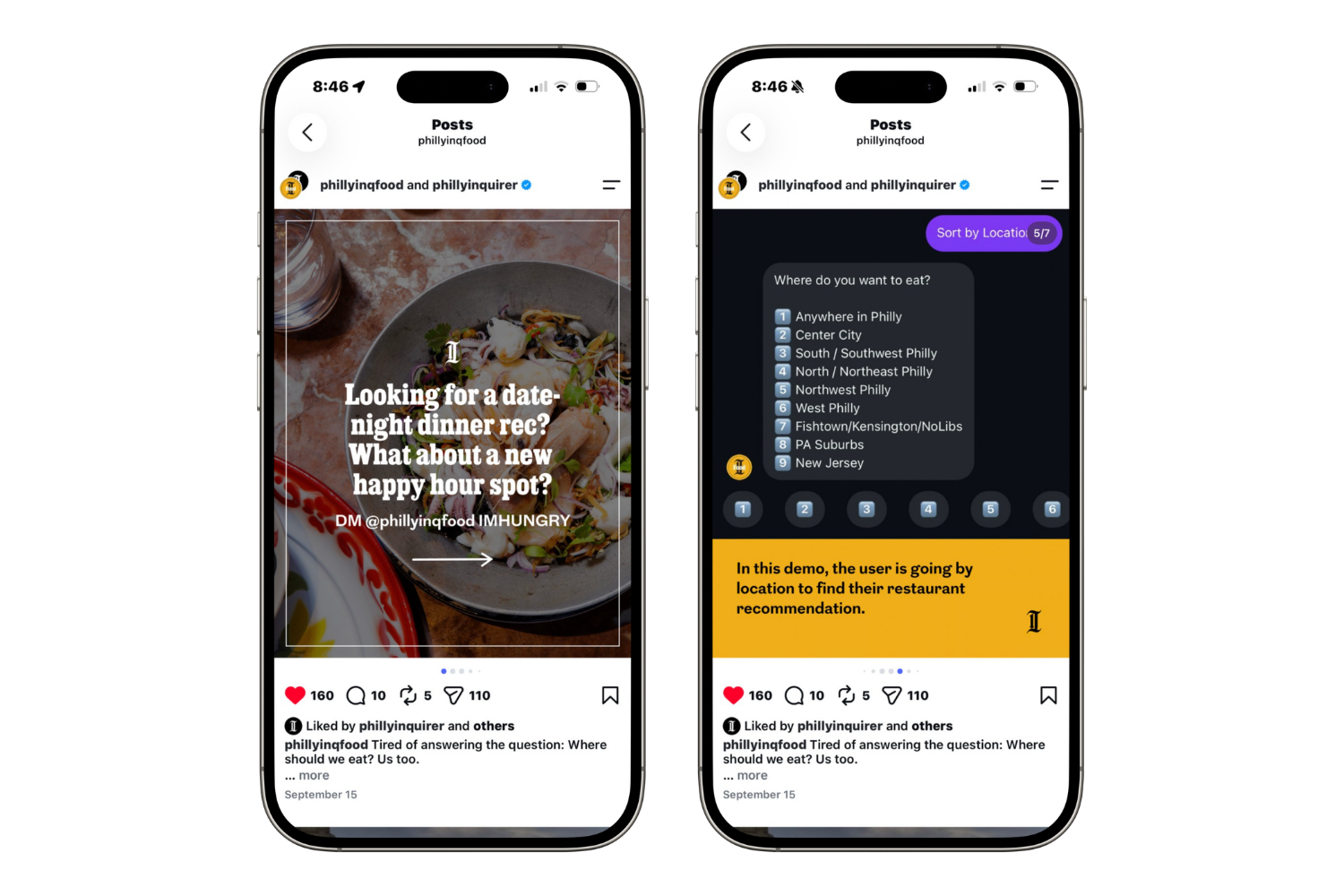
Their first idea was to facilitate a group chat where users could ask the Inquirer what to eat.
Using a Rose, Bud, Thorn process, they found what worked, what was promising, and what was still a friction point. The team had an openness to the utility use-case for AI, and saw promise in offering both the critic’s expertise and an automated experience to the reader through messaging apps. Interviewees, however, hesitated to share personal phone numbers.
Those findings led them to refine their prototype idea. Instead of asking for a phone number, they would move the experience to Instagram DMs, without requiring personal information from audience members or waiting for them to come to the outlet’s owned-and-operated platforms.

How The Texas Tribune and The Philadelphia Inquirer matched needs to strengths
What this means for your newsroom
The instinct after synthesis might be to build against the most promising opportunity or try to solve the largest pain point. Both approaches skip foundational questions, however, such as where audience needs and organizational strength overlap.
Instead, a step-by-step design sprint helps teams find the right problem to design for as they focus on building the right thing. An impact-and-effort matrix helps you understand what an idea costs before you commit to it. The Rose, Bud, Thorn framework keeps you aware of the opportunities downstream and potential points of friction.
The Texas Tribune set aside the top need in its research because the organization wasn’t equipped to deliver the solution required. The Philadelphia Inquirer dropped asking for a phone number because its audience shied away from that. Both teams traded a promising idea for a problem they could solve with what they already had, and made that call before spending further resources.

Follow the Sprint

NEXT