Localize the findings

The Next Gen News 2 report, researched and produced by FT Strategies and the Northwestern University Knight Lab, gives you a comprehensive picture of how a new generation of news consumers is reshaping engagement with news globally. Chances are, your own local audience shows up somewhere in those insights. Finding out where, and what that means for your newsroom, is how we start.
Why this matters
At the News Product Alliance, we build audience research into every program we run. Without it, product decisions tend to drift toward what a newsroom finds interesting or leadership prioritizes, rather than what the audience needs.
Not everything in the NGN2 report will apply directly to your local community. This is the moment where you start reading your local audience through the report’s modes of engagement and identify which insights are also present locally, building the foundation for every decision that follows.
The method
1 | Take stock of what you already know.
Your newsroom probably has more data than you think. Before you research anything new, audit what you already have. Look at existing surveys, analytics, newsletter data, past projects, and third-party research like the NGN2 or reports from the Pew Research Center.
The Next Gen Data and Insights Inventory is a worksheet to capture what your team already knows before designing any new study. Not everything your audit surfaces calls for the same response.
Act on what you know with confidence.
Test locally what’s indicated by outside research.
Validate anything you have been assuming.
Investigate anything you don’t know yet.
As audience and product consultant Ariel Zirulnick explained to the newsrooms participating in the GNI × NPA AI-Powered Next Gen News Sprint, keeping those categories separate prevents guesswork from driving your strategy.
As you audit, note what your existing data says about modes of engagement. Social analytics might show you who finds you while scrolling, search traffic can point to who seeks information and newsletter or app data will signal who subscribes.
The expected outcomes of this step are a shared map of your team’s existing knowledge and a clear set of open questions to carry into the research process.
Resource:
2 | Plan research that fills the gaps.
With the inventory in hand, focus on what you still need to learn. A focused research plan keeps the phase in scope and makes sure you produce something usable.
The Next-Gen Research Plan is a template that forces you to be specific before you start. It helps you define your target audience, frame research goals, and complete one decision sentence: “After this research, we will be able to decide whether/how to…”
From there, you choose methods that match your research goals; identify any lived experiences or demographic characteristics that must be represented among participants for the research to be credible; and lay out how you’ll recruit them.
The outcome of this step should be a research plan tied to a specific product decision your team needs to make, with methods, perspectives, and recruitment scoped.
Resource:
3 | Ask your next-gen audience.
Go to your audience directly. Use surveys for scale and quantitative data; use interviews for habits, motivations, and attitudes. These methods can also work in sequence.
For next-gen audiences, two participatory methods are worth considering: journey mapping (go through a real decision with someone, step-by-step) and a radar exercise (where they place topics into concentric circles by relevance).
Sort out recruitment first. If next-gen community members aren’t in your databases, go to them: campus email lists, alumni networks, employers with early-career staff, community spaces, local creators. Offer incentives.
The result will be fielded research that gathers responses from people who represent the audience you set out to study.

4 | Synthesize what you heard into a strategic challenge.
The synthesis moment is where you turn what you heard into a strategic challenge on which you can build the rest of the process.
First, clean and structure your data.
For surveys, remove duplicate responses, split compound answers, and tally the frequency of specific answers.
For interviews, turn long narratives into one-observation-per-row units, making sure you capture observations, not interpretations.
Then use the Next-Gen Synthesis Worksheet. This resource will take you from clustered observations to design mandates and actionable recommendations.
The expected outcome of this step is three to five mandates, each connected to your research, that you can take with you to a design-thinking session.
Resource:

How the Tampa Bay Times and Deep South Today tamed the starting point in research
Many research phases start with a blank page, and a blank page can be intimidating. Who are we trying to reach? What do we need to know about them? Where do we even begin?
But there’s no need to start from scratch. Newsrooms sit on far more data than they imagine, in their analytics dashboards, their past projects, and industry research. A structured audit of what’s available can tell you where to begin and where to focus next.
Two snapshots here follow the Tampa Bay Times and Deep South Today as they ran that audit during the GNI × NPA AI-Powered Next Gen News Sprint, using the Data and Insights Inventory.
Finding gaps to know what to ask
Tampa Bay Times started with data that was already available. U.S. Census Bureau data showed that the average population of the Tampa Bay area was growing, with 40 percent of the population under 29 years old. This quickly showed them the size of the opportunity.
Working with the Data and Insights Inventory, this team took stock of what they had: national research, their own analytics, and prior work. Three people, all new to the newsroom, conducted this review, and noticed that the gaps could be addressed by a survey that reached local students.
This survey validated most of their hypotheses: The local next-gen audience wanted a more digestible way of receiving complex stories, preferred short-form videos on TikTok and Instagram, and leaned heavily into things-to-do/lifestyle content.
The organization even found what didn’t resonate with this group, when they offered a $50 incentive for a follow-up interview. Plenty of students were willing to complete the survey, but fewer were willing to engage in a conversation. The team took this as an insight about habit formation: Getting to a user once doesn’t mean you’re guaranteed return engagement.
From the survey, they narrowed the scope even more and focused on the potential next-gen audience that is new to the Tampa Bay area.
“It’s not that we’re just wanting to reach young people; we’re wanting to reach young people who are new to the area,” explained Christian Blauvelt, Assistant Managing Editor, Digital Engagement, at the Tampa Bay Times. “People who are new to the area are often interested in the same things that young people are interested in: things to do, places to eat, lifestyle content.”
Auditing the funnel to see where they are
For this sprint, the Deep South Today team started from the distribution end, focusing on next-gen audiences of its flagship newsroom, Mississippi Today. Rather than asking an open-ended question about young people and news, the team turned to young audiences it already reached but wasn't converting. That gave the research a clear focus from day one.
For its Data and Insights Inventory, the team audited analytics across Mississippi Today's digital footprint and reviewed industry research on news consumption, including the Next Gen News 2 report and Pew Research Center data, alongside trends in charitable giving. The audit confirmed the gap: Mississippi Today had a sizable following on Instagram and TikTok, a sizable portion under 30, yet few of those followers made their way to its owned-and-operated sites.
So the team went where that audience already was. Using paid social ads on Instagram and TikTok, they recruited people ages 18 to 28 to take a survey.
Two needs stood out. Respondents felt informed after engaging with Mississippi Today's journalism but didn't feel empowered to act on it. And while most had limited financial resources, many said they actively support causes they care about, often through small-dollar donations.
"There's a misconception that this generation doesn't want news. They do. They want information they can act on," said Cherry Agarwal, Director of Audience at Deep South Today. "That was the light-bulb moment. The traditional funnel asks people to discover you, come to your site, and only then think about giving. We flipped it. We designed for the moment they want to act, right where they're already consuming information."
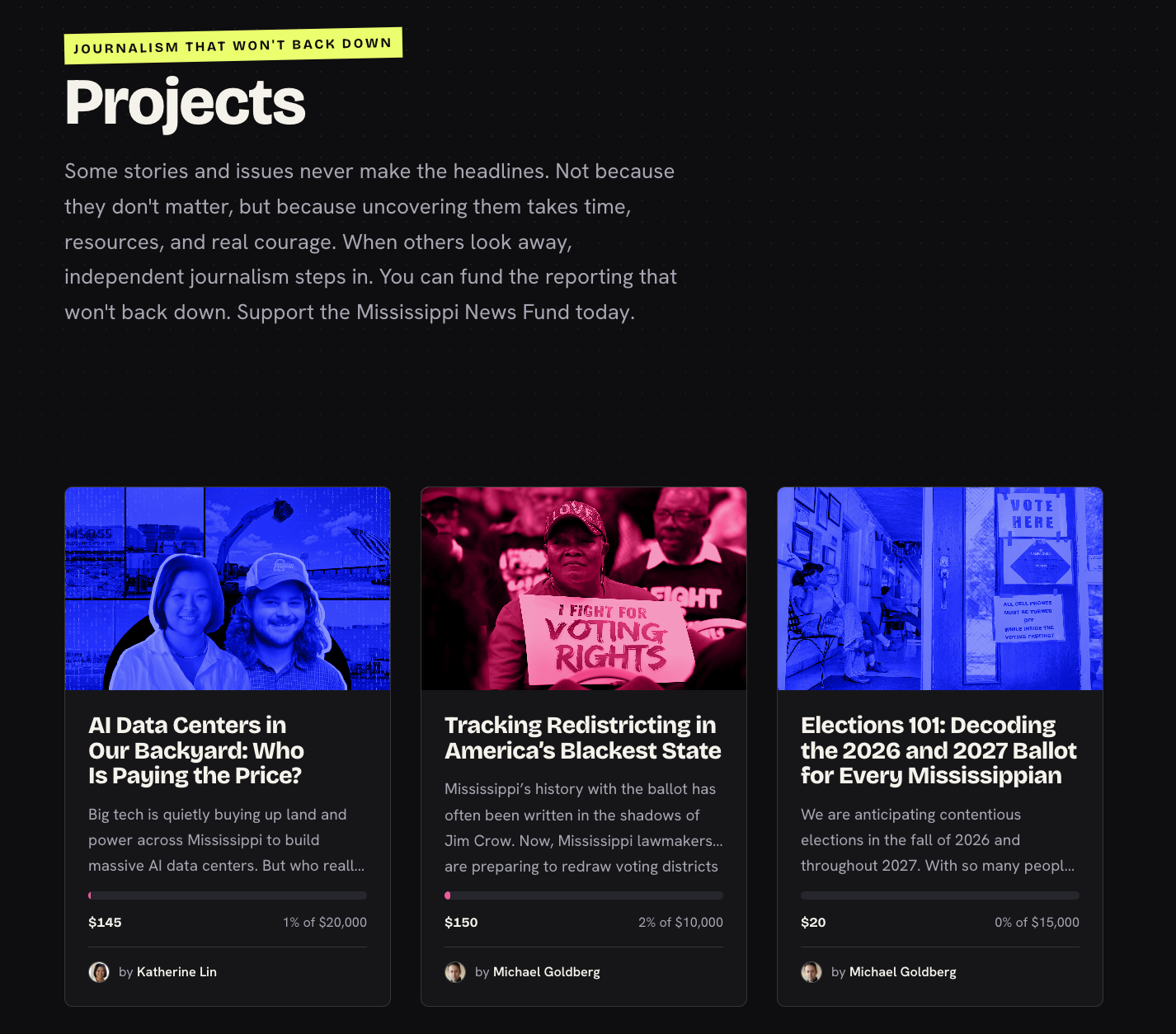
That insight became the Mississippi News Fund, a micro-donation platform that lets young readers fund specific reporting projects at a level that fits their budget, without leaving the platforms where they found the story.

What this means for your newsroom
Before writing a single survey question, both teams narrowed the scope of inquiry. They used the Data and Insights Inventory to decide not only what was worth asking, but also who to ask. The Tampa Bay Times read its market, while Deep South Today read its distribution and audience activity.
In both cases, the audit revealed what they still didn’t know and where to recruit: local colleges for the Tampa Bay Times, Instagram and TikTok for Deep South Today. Even how people engaged with the research became data in itself.
Regardless of its size, your team can follow the same sequence. At the Tampa Bay Times, three people new to the newsroom ran the whole review.
Moving from general data to particular observations is what surfaces concrete needs and specific audience segments to reach. Those are the insights worth designing around, the ones that lead to products and experiences that connect with the next generation of news consumers and gather the evidence to get buy-in from your organization.

Follow the Sprint
NEXT