

The feedback inboxes at Lookout’s two newsrooms in Santa Cruz, Calif. and Eugene, Ore. see dozens of emails each week — everything from PR pitches to newsletter delivery problems to cancellation requests. It is difficult for busy staff to find a signal in all that noise, and make sure they respond to urgent customer service questions.
Lookout’s leadership team used the Audience Data Commons (ADC) schema to create a framework that lets the newsrooms’ national support team evaluate, gauge and respond to feedback in a consistent way. The resulting listening tool helped the newsrooms confirm that a surprise $250 annual membership renewal was their largest churn driver.
Data in
The people who email Lookout with customer service questions or story ideas are mostly paying members, and they are among its most engaged audience members. In an ADC pilot with the NPAI Co-Lab, the organization’s former Director of Audience Growth & Engagement, Chris Hammond, sought to analyze hundreds of open-ended messages to get a more holistic sense of the feedback coming in.
The data that Lookout used for the pilot was stored in two shared newsroom feedback inboxes that business team members can access. Hammond said the schema presents “a way for them to read their support inboxes as a single signal instead of hundreds of one-offs.”
Before the pilot, the team, which includes CEO / Founder Ken Doctor, Chief of Staff Ashley Harmon and two community engagement specialists, would see themes emerge in the inboxes as they triaged and replied to messages. Without an organized evaluation structure, though, whether they found the email urgent or significant was ad-hoc and inconsistent.
How the schema worked
With about 150 standardized Gmail exports on hand, Hammond applied the schema's framework for parsing the intent behind each message through Claude. He verified the output against a small hand-tagged reference set.
The ADC schema helped Lookout convert open-ended messages into a spreadsheet with structured tags that they used to find patterns. Custom renewalSurprise and cancellationIntent tags identified cancellation and refund messages. A resolutionStatus tag surfaced emails with no staff response, while a respondedBy tag helped them triage messages correctly. A simple memberNeedSummary tag lets them share findings with Lookout’s leadership team without exposing individual member details.
Insight out
These insights did not stay in a spreadsheet. After completing the analysis, Hammond used Claude to build an inbox intelligence dashboard powered by data from the ADC.
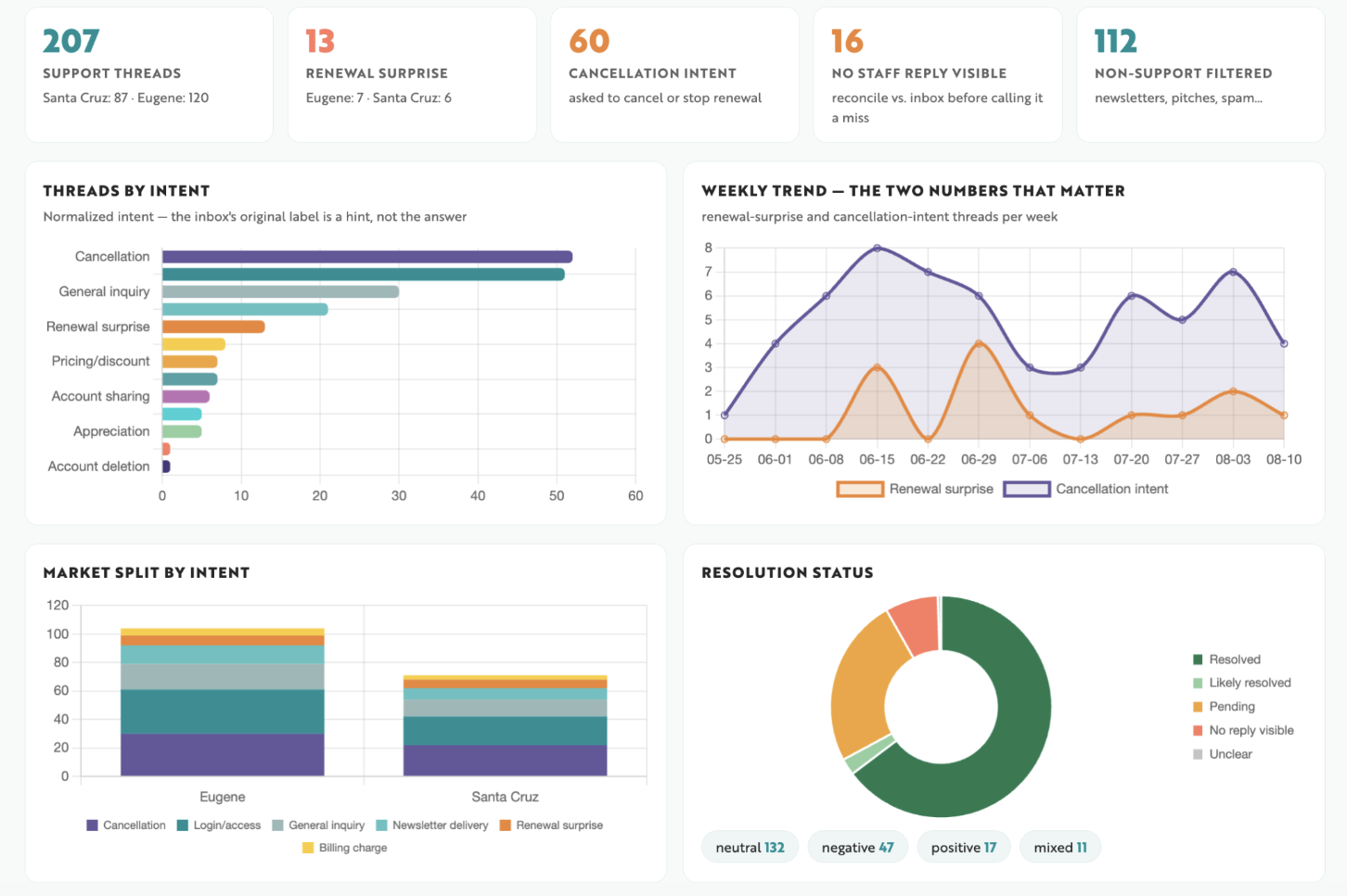
Image: Lookout
The dashboard is designed to help staff see feedback patterns that were not visible before. It also allows for pattern comparison across the organization’s two markets, and shows them where member support breaks down or slows down.
“One of the intangible value propositions that Lookout offers is a dedicated real person responding to an individual member,” Hammond said.
Lookout’s business team used the schema and dashboard to confirm that many members were surprised by unexpected annual charges, usually a $250 founding-membership renewal, and that the surprise often drove them to cancel. Based on this, they are considering pre-renewal notices, a shared reply template, and a more consistent approach to retention offers in an ongoing attempt to mitigate churn. One key data point is still missing from the schema: anonymized data lacks a member ID, so Lookout cannot connect a complaint to whether that member ultimately canceled.
Hammond said that despite this challenge, the data created by the ADC schema could help Lookout anticipate the impact of future strategic decisions. As the newsrooms consider rate increases and new membership tiers, having a finger on the pulse of audience sentiment can help them plan an effective rollout strategy. Eventually, Lookout wants to explore linking the schema to Newspack and WooCommerce, the CRM where they store members’ profile information. Harmon said the data is helping them “decide priorities for different UX projects and ideas for how to address messaging gaps.”
Where it got hard
Newsrooms looking to use the ADC schema on their own feedback inboxes should be prepared to work with whatever historical window of data they can actually access. Hammond couldn’t access the entire archive of Lookout’s shared inboxes, but the smaller subset he started with worked fine.
The schema also lacks some identifying fields that would help with analysis — some of which could be added by integrating it with Lookout’s CRM using unique identifiers like email address and name. Fields for message and reply timestamps and clear records of staff outcomes such as refunds or retention would help; as would a reliable way to separate genuine support requests from PR pitches, spam, event submissions, editorial feedback, and internal mail.
Despite this, Lookout could not have built the inbox custom intelligence dashboard without the ADC schema. Hammond recommends that newsrooms wanting to activate open-ended audience data start by defining exactly what makes an engaged member and ask themselves: “You’re trying to better understand intent and sentiment; among who?”