NPA Summit 2026: Session Proposal Guide
The NPA Summit program is built by the community, for the community. Each year, the sessions that resonate most come from practitioners who are doing the work — people who have something hard-won to share, a challenge worth working through together, or a perspective the field needs to hear.
How to Complete Your Session Proposal
The information you share in the form helps us understand your idea, and if selected, present your session clearly to attendees. You don’t need to overthink any single field; together, they tell the story of what you want to share and who it’s for.
Below, you will find detailed information about what is included in the form.
Session Title
Your session title is the first thing attendees see on the schedule — and often the only thing they read before deciding whether to show up. A strong title signals the core idea, avoids insider jargon, and hints at what someone will walk away with or rethink.
A few examples from last year's program that do this well:
"Quantifying Feels: Building Editorial Success Metrics for AI" — leads with a provocative phrase that earns its explanation, and tells you exactly what the session is about;
"Leading Product in News: What No One Tells You" — speaks directly to the audience and signals that the conversation will be candid, not theoretical;
"Keep that Research Off the Shelf: A Crash Course in Operationalizing Audience Insights" — names the problem, signals the format, and promises a practical takeaway, all in one line.
Notice that none of these titles tries to cover everything the session does. They make one clear promise and trust the description to fill in the rest.
If your session is selected, your title may be lightly edited for clarity or consistency with the overall program.
Session Description
This is the public-facing description attendees will see on the Summit site and schedule. It's your best opportunity to convince someone that your session is worth their time, so lead with the problem or question you're tackling.
A strong description does three things: it clearly names the challenge or topic, explains what the session will actually explore or do, and helps the reader understand what they'll leave with. You don't need to outline every agenda item. Focus on the outcome and why it matters to someone in this room.
The descriptions that land best open with a tension or a sharp observation rather than a setup paragraph. Avoid openers like "In this session, we will explore…" or "This session will discuss…" because they bury the actual idea and give the reader no reason to keep reading. For example, here’s a great opening line from last year’s program: "Broken analytics pipelines lead to broken product decisions, yet most teams only discover the cracks after OKRs slip." (from "Data Therapy: Smarter, Simpler Fixes for Your Analytics Stack").
Aim for 150–300 words. If your session is selected, your description may be lightly edited for clarity or consistency with the overall program.
Session Purpose & Takeaways
This field is for the NPA team and community reviewers, not for public display. Use it to share the thinking behind your session: what you want participants to leave with, how you plan to structure the time, and the experience or expertise you're bringing to the topic.
You might use this space to describe:
The type of learning or insight you want to enable;
Whether participants will leave with new ideas, strategies, skills, or connections;
What success looks like for this session;
How you plan to structure and pace the session;
The background or experience that makes you the right person to lead this conversation.
This is where reviewers get to know you and your vision for the session, so be specific. A clear sense of structure and a grounded sense of your own expertise will strengthen your proposal considerably.
Theme Alignment
Themes help us ensure the program reflects the Summit's overall focus and balances sessions across core areas. Select the theme most directly connected to your session. You don't need to force alignment with multiple themes, but you may choose up to two if your session genuinely spans both.
For this year's Summit, we're looking for sessions that connect to one of the following:
Audience Intelligence & First-Party Data Systems: How news organizations build, connect, and operationalize first-party audience data to turn research and signals into decisions, products, and strategy;
AI-Native News Operations: Designing newsroom workflows, tools, and governance models where AI is embedded into everyday operations—not layered on as an experiment;
Sustainable, Audience-Led Business Models: Aligning revenue strategies with audience value creation through product-led monetization, trust, loyalty, and long-term retention;
The Future of Distribution & Non-dependability: Navigating platform volatility by building direct relationships, reducing dependency on search and social, and regaining strategic control over distribution;
Product Leadership in Uncertain Times: Leading cross-functional teams through change by designing organizations, decision frameworks, and accountability systems built for uncertainty.
You don’t need to force alignment with multiple themes—choose the one or two that best fit your session’s focus.
Audience Category (Who This Session Is For)
This field helps us build a program that's balanced and useful across different kinds of work. Choose the category that best reflects the decisions or challenges your session is designed to support. There's no single right answer, and your selection won't disqualify a strong proposal, as this helps us understand where your session fits within the overall program.
Building Systems & Infrastructure: Designing or implementing audience data, AI, product, or operational workflows and systems;
Making Strategic Decisions: Setting direction, priorities, or guardrails around AI, data, platforms, or long-term risk;
Turning Audience Insight into Value: Connecting audience understanding to products, services, revenue, trust, or retention;
Leading Teams Through Change: Guiding teams and organizations through change, restructuring, or uncertainty.
Choosing the Right Session Format
Choosing the right format is one of the most important parts of a strong proposal.
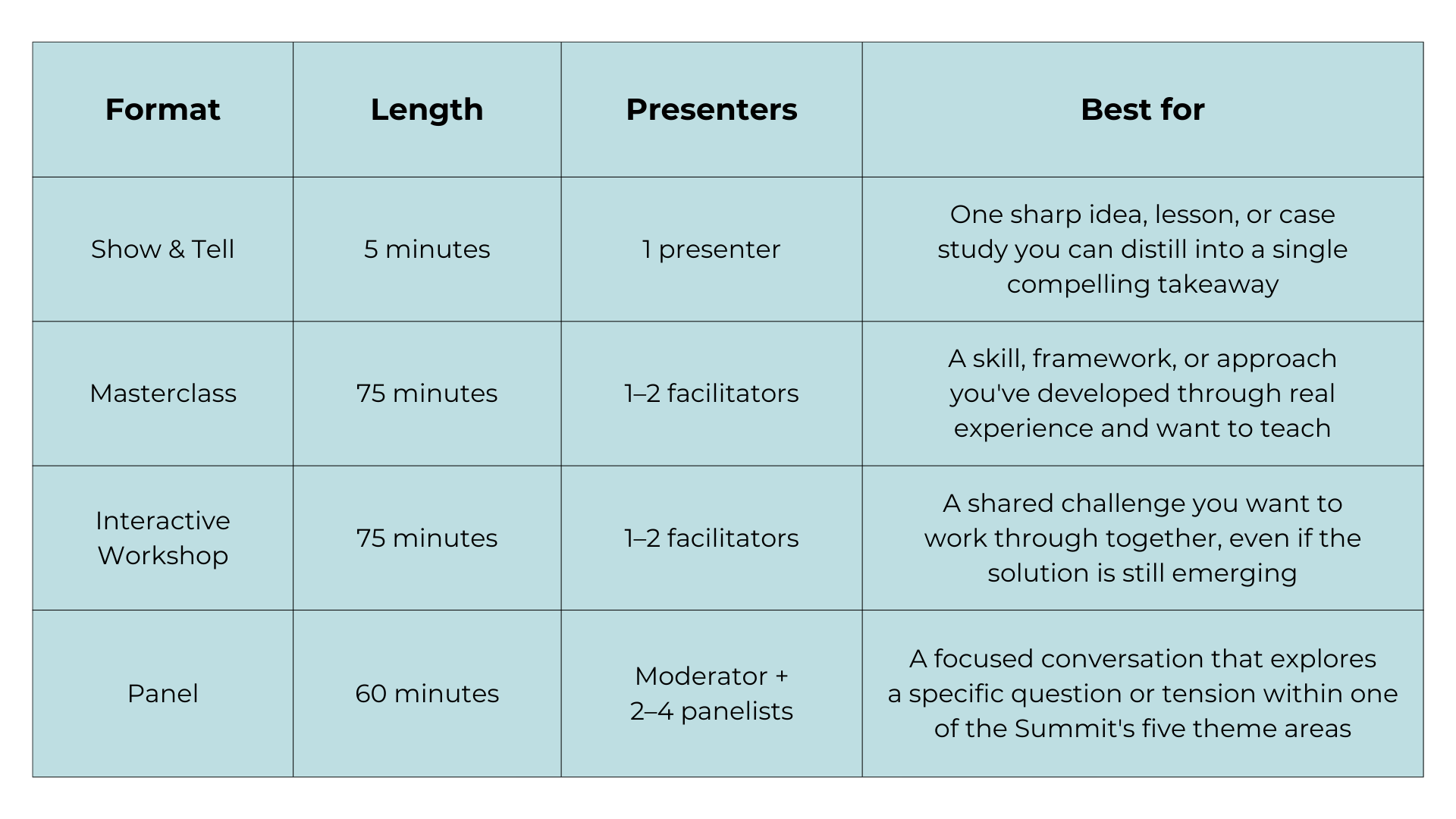
Not sure which format fits your idea? Use this table to find your starting point, then read the full description below before submitting.
Show & Tell
5 minutes | 1 presenter | Auto-advancing slides
A fast, focused ignite-style talk built around one clear idea, lesson, or case study. The best Show & Tells are opinionated, grounded in real experience and designed to spark new thinking rather than explain everything you did. If your talk can be distilled into a single compelling takeaway and delivered in five minutes, this is your format.
This is the right format if you learned something surprising or perspective-shifting, you have one big idea that reframed how you think about product, audience, or AI, or you want to share a specific lesson rather than a full project overview. We're looking for proposals that are tightly focused, energizing, and make the takeaway immediately clear.
Masterclass
75 minutes | 1–2 facilitators
A structured skill-building session designed to help participants deepen their understanding or develop a new capability. Masterclasses can be sit-and-learn, hands-on, or a mix of both. The primary goal is teaching something people can apply when they return to their newsroom.
This is the right format if you've developed real expertise in a tool, framework, workflow, or approach and want to help others do it better. There should be a clear skill or method participants will leave with. We're looking for proposals that articulate specific learning objectives, demonstrate real-world experience rather than theory, and show thoughtful consideration of pacing and participant needs.
Interactive Workshop
75 minutes | 1–2 facilitators
A facilitated, participatory session where attendees learn by doing or collaborating around a shared challenge. Workshops prioritize engagement over presentation and often involve structured exercises or guided discussion. You don't need to have everything figured out, as this format is about creating the conditions for meaningful exchange.
This is the right format if you're grappling with a challenge others in the field are also facing and the value comes from collective thinking and collaboration. We're looking for proposals that clearly define the problem participants will work on, show intention around facilitation, and create opportunities for shared insight or tangible takeaways.
Panel
60 minutes | Moderator + 2–4 panelists
A focused, topic-driven conversation tied directly to one of the Summit's five core theme areas. Rather than broad overviews, panels are designed to explore a specific question, tension, or decision within a theme. Strong panels bring together complementary or contrasting perspectives, feel intentional and opinionated, and help the audience understand how leaders are navigating real tradeoffs.
This is the right format if you want to shape a high-quality conversation within one of the five theme areas, you can articulate a clear point of inquiry, and you can contribute a meaningful perspective or suggest others who can. We're looking for proposals that have a well-defined focus, and are designed to go deep rather than cover everything.
If your panel proposal is selected, you'll serve as moderator. That means you'll be responsible for identifying and recruiting your panelists, preparing them for the conversation, and shaping the discussion arc, with support from the NPA team throughout the process. Come with a clear sense of who belongs in that conversation and why.
Co-Facilitation and Panelists
How you complete the proposal form will depend on your session format.
Masterclass and Interactive Workshop proposals can be submitted by one or two facilitators. You only need to submit one proposal per session — if you're co-facilitating, add your partner's name, title, organization, and email when prompted in the form. There's no need for both of you to submit separately.
Show & Tell proposals are individual submissions. This format is designed for a single presenter, so the form does not include an option to add a co-facilitator.
Panel proposals are also individual submissions — you'll be pitching as the moderator of your panel, not as part of a group. The form includes an option to add your proposed panelists' information and indicate whether they have already confirmed their participation. If you don't have panelists confirmed at the time of submission, that's okay — you can use the additional context field to share who you have in mind and where those conversations stand.
How Sessions Are Selected
All proposals are reviewed by a community review panel made up of practitioners from across the news product ecosystem, who read submissions and share their top recommendations with the NPA team. We use that input to curate the final program, balancing community priorities with session mix, theme alignment, and a breadth of perspective from across the field.
What reviewers are looking for:
Real-world grounding — proposals rooted in concrete experience, lived examples, and tangible outcomes, not theory alone;
Practical value — sessions that deliver something useful to both the senior leader setting direction and the practitioner doing the work;
Focus on systems and decisions — how teams actually operate, prioritize, and ship;
Agency and ownership — content that empowers participants to lead change and build what comes next;
Theme alignment — a clear connection to this year's focus on moving from reaction to readiness.
Strong sessions come from clarity of experience, not completeness of expertise. We intentionally curate a program that reflects a wide range of perspectives, roles, and lived experiences across the field—and we design our formats and review process to support a generous, inclusive environment for shared learning.