As 2025 comes to a close, the NPA team is taking stock of a year of significant growth for our organization and the news product field. We're grateful to count on many partners who have been instrumental in helping us advance product capacity at every level: developing individual leaders, strengthening organizational practices, and building shared infrastructure for the journalism ecosystem.
Growing our Community and Building the Talent Pipeline for News Product Leaders
We developed 58 new product leaders through our News Product Management Certification (NPMC) program, expanding our global alumni network to 120 professionals who are now driving transformation in their newsrooms. Thanks to the Knight Foundation, we were able to offer scholarships that enabled participation from local news organizations that otherwise could not access this level of training and we will continue to do so in 2026.
A special shout-out to Sydney Lewis, a 2025 NPMC graduate, who applied the program's frameworks to conceive and launch Strib Varsity at the Minnesota Star Tribune. The results speak to the power of trained product leadership: the vertical now drives 4× higher subscription conversion than the main site and accounts for 11% of all new subscriptions, while generating new revenue streams through targeted sponsorships. This is what happens when product leaders can connect audience needs to sustainable business outcomes.
We will host two new cohorts in 2026 and are excited to continue building this community of practice that's reshaping how journalism serves audiences.
Convening the Field
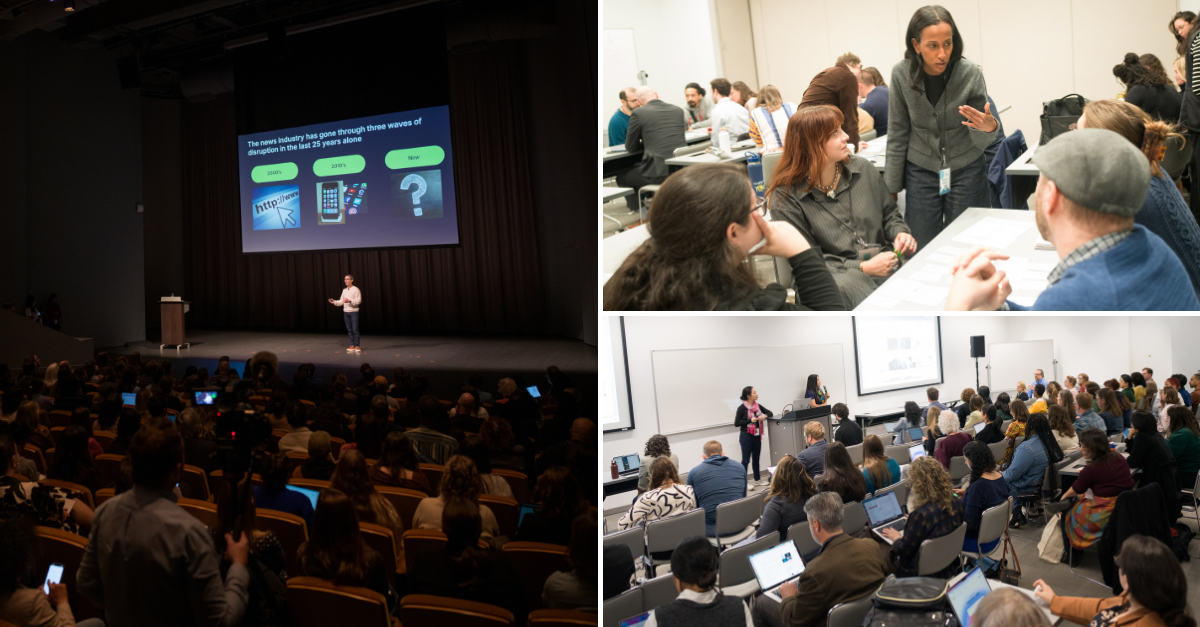
In October, we convened 400+ professionals to accelerate field-wide learning and collaboration at our first in-person, sold out NPA Summit. This new format created the conditions for deeper collaboration, spontaneous problem-solving, and relationship-building. The Summit by the numbers:
400+ participants representing 300+ news organizations.
83% of attendees are engaged in product work, either formally or informally.
70% of attendees influence or make strategy, budget, or purchasing decisions.
49.5% of attendees self-identified as members of historically marginalized communities.
50+ sessions across 8 focus areas, blending strategic conversations and hands-on learning.
93 facilitators, 42.5% of whom self-identified as members of historically marginalized communities.
9.26/10 overall satisfaction rating.
The Summit drew senior decision-makers and forward-thinking practitioners who are shaping how newsrooms respond to AI disruption, audience fragmentation, and evolving business models. These attendees aren't waiting for the future of news to arrive; they're the ones actively building it from within their organizations. By creating dedicated time and space for our community to share practices and co-create solutions, we're accelerating the pace at which good ideas spread across the industry.
Using AI to Understand and Serve Audiences Better
As audience behavior continues to shift faster than newsroom capacity, AI has moved from an optional experiment to a structural question for the field. Our focus has been consistent: building shared, reusable infrastructure so AI adoption strengthens journalism rather than fragmenting it.
Through the NPAi Co-Lab we’re developing open-source AI infrastructure to solve one of journalism’s most urgent challenges: understanding and engaging audiences. Most newsrooms collect valuable audience signals but can't effectively use them because data is scattered and unstructured. This year, we established the Audience Data Commons, a shared, open schema for building first-party audience data infrastructure, to enable newsrooms to better reach their audiences.
Thanks to the renewed support of the McGovern Foundation, in 2026, we will productize and scale adoption of the Audience Data Commons and ensure that small and local newsrooms have the infrastructure, resources, and community support to responsibly and effectively adopt AI.
With Google News Initiative, we supported C-Suite leaders at news organizations across Latin America to establish a vision and bridge the gap between strategy and execution for AI adoption. The program is generating field-tested materials that will strengthen our future ability to support newsrooms at scale.
Additionally, in 2026, we're launching the GNI × NPA AI-Powered Next Gen News Sprint, bringing together leading U.S. publishers to understand next-generation audiences and test AI-enabled approaches to reach and serve them.
Together, these three programs are building a library of practical, scalable tools for the industry at-large. At a moment of unprecedented investment in local news, our work focused on ensuring those dollars translate into lasting organizational capacity.
Product as infrastructure and what’s next for 2026
As demand for this work continues to grow, our focus in 2026 is on scaling what’s already working without losing rigor, accountability, or community trust. We're running multiple capacity-building programs concurrently, launching new NPMC cohorts, and fostering new ways to bring our community together.
Our 2025 State of Product Management in Journalism Census confirmed what we're seeing in the field: newsrooms with strong product structures report better revenue outcomes and fewer operational challenges, yet most organizations still lack the capacity to build this muscle. This is why NPA exists: to provide the infrastructure, training, and community that help the field move from isolated progress to durable, shared capacity.
We look forward to continuing this work together in 2026!