
Young audiences aren't checked out. They care about what's happening around them, they're curious and are building their own information ecosystems. Most news organizations, however, don’t seem to appear in them. This goes beyond a distribution challenge. It is a relationship question that needs an answer before it’s too late: Can newsrooms figure out how to build real bonds with these new audiences when their habits keep evolving and the tech landscape keeps shifting?
The GNI × NPA AI-Powered Next Gen News Sprint was built around that urgency. Over eight months, 12 forward-thinking U.S. local news organizations are doing the work: conducting original audience research, prototyping new ideas and building the internal capacity to keep experimenting on their own. AI is part of the toolkit. So is peer learning, expert coaching and a willingness to experiment and learn fast.
In early March, the cohort gathered in Columbia, MO for the program's centerpiece: a three-day design sprint at the Reynolds Journalism Institute. Here's what happened.
Learning the terrain
Before anyone started sketching, product leads spent a full day reckoning with what it means to lead AI products inside a newsroom right now. Organized and facilitated by our friends at RJI, the sessions covered what’s working and what’s not in news, as well as what we can learn from industries such as fashion, health care, and agriculture.
These disparate sectors currently face a number of similar challenges, with many lessons for newsrooms. Our initial sessions, including a hands-on vibe-coding workshop, took aim at a practical question: What does a newsroom actually need in this moment to champion ethical AI adoption, and how can product methodologies help with that?
Solving the right problem
The sprint’s design phase kicked off with some key questions: Who are we serving? What problem is actually worth solving for them? What does it mean for a newsroom’s relationship with next-gen audiences if that problem gets solved? If a solution is to take shape during the design process, the problem you’re addressing needs to be clear.
Teams arrived with ideas that felt, from the outside, fairly defined. I’ll be honest: I was afraid that everyone would converge on the same diagnosis and the same answer. Yet that didn’t happen. Every prototype that came out of those two days was distinct, shaped by each team’s specific audience research, community context, and strategic moment. Each was thoughtful, grounded in what the team knew about next-gen audiences, from the Next Gen News 2 report and their own guided research process.
These are some of the insights they addressed.
Next-gen audiences most frequently discover news incidentally through social media, less so through intentional visits to news sites.
They want content and coverage that feels relevant to them and provides a clear path to action, not just information.
AI as part of a workflow or as an assistant seems to be acceptable, but full automation could break audiences’ trust.

Participants discuss their ideas during the in-person design sprint.
Getting in a room together
Teams that served entirely different markets, communities, and audiences were genuinely invested in each other’s work. They asked questions, pushed back, and made real suggestions on each other’s prototypes.
This collaboration didn’t happen by chance. We made sure to create space for rich exchange of ideas, and the teams are enthusiastic to keep supporting each other.
What about AI?
There was no expectation for anyone to fully build an AI product. Instead, we offered teams tools that supported them in fast prototyping, leveraging the available technology to test ideas before committing to them. It was important for teams to build the internal capacity to keep doing this on their own.
AI showed up because it was useful, and it became a feature of the products that teams created because it brought value to their younger audiences and solved worthy business problems.
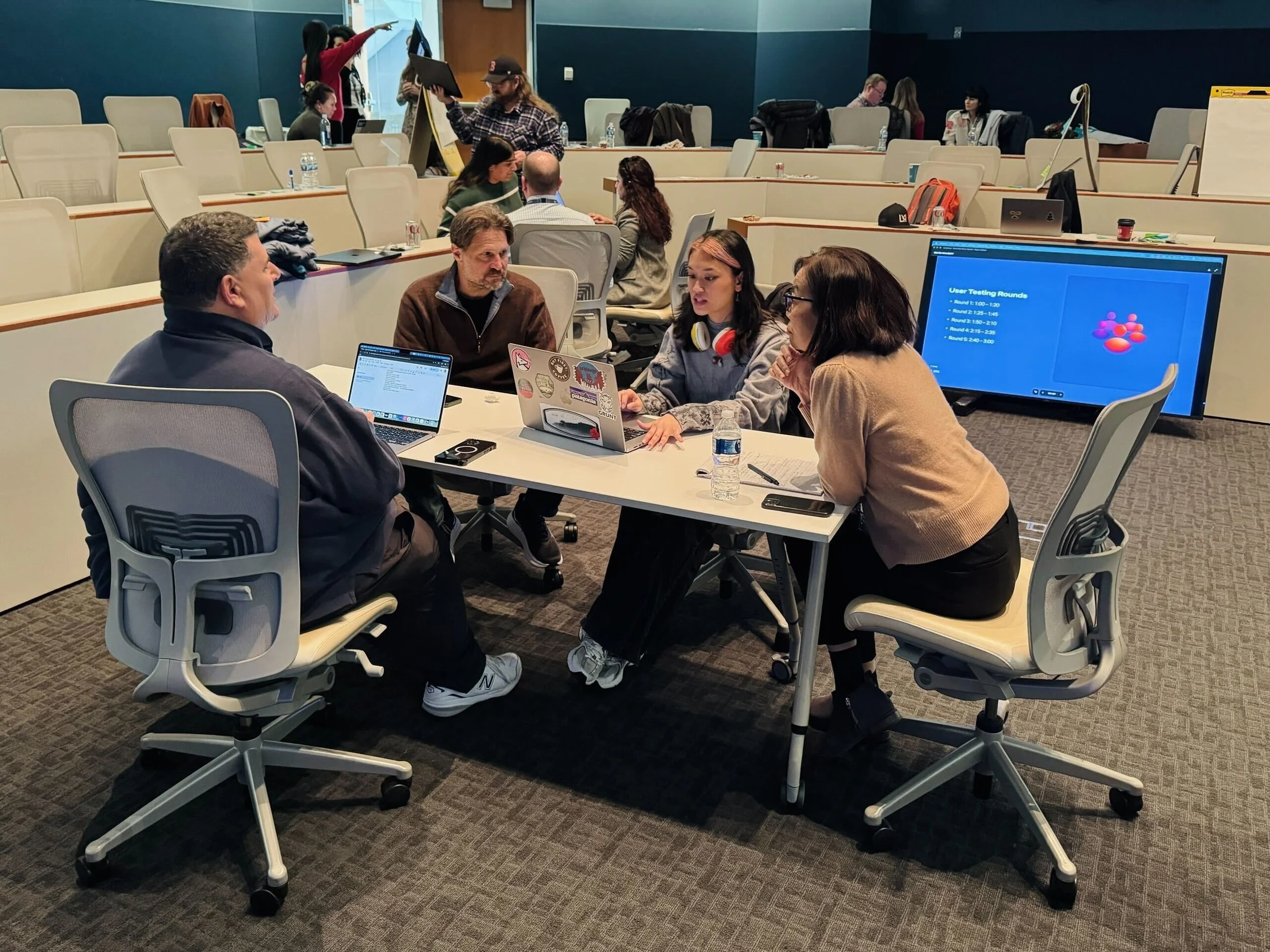
Rapid iteration and discussion. Photography by Damon Kiesow, RJI
What comes next
The end of the sprint, of course, isn’t the finish line. Over the next 6 months, the 12 newsrooms will complete a guided implementation phase in which they turn prototypes into minimum viable products, measuring what works and iterating together.
Coaching, peer learning, and sharing lessons are all central to our work in this initiative. That’s the thing about navigating this moment: There’s too much uncertainty to figure it out alone. We can get to the answers faster if we learn together, with structure and support.
That’s what we set out to build with this program. By the end, it won’t just be 12 newsrooms with answers. They’ll also create a set of open resources for anyone who, like us, is working on serving the next generation of news audiences.
We want to thank the Reynolds Journalism Institute and the Northwestern University Knight Lab in this process, as well as our coaches and facilitators: Ariel Zirulnick, who guided the teams through the research process, and Drue Thomas, who gracefully worked with them in person to take them from problems to solutions.